Tonnage gets all the attention. It is the number on the machine, the number in the model name, the number buyers lead with when they call. And it is only half the machine.
An injection molding machine is really two machines bolted together: a clamp unit that holds the mold shut, and an injection unit that fills it. Specify the clamp correctly and the injection unit badly, and you have bought a machine that cannot make your part properly. This happens more often than the industry likes to admit, because almost nobody asks about shot capacity until something goes wrong.
Shot size and shot capacity are not the same thing
Shot size is how much material your part actually requires per cycle. Shot capacity is the maximum the machine’s injection unit can deliver. The relationship between those two numbers is what determines whether your process is stable.
Calculating what you need is straightforward, and it is worth doing before you talk to anyone about machines:
(part volume × number of cavities) + sprue and runner volume + an allowance for packing and shrinkage compensation
Two things people routinely forget. The feed system counts: sprue, runners, and gates are material the machine has to deliver, even though they are not part of the product. And cavity count multiplies everything, which is why a machine that was correctly sized for a prototype single-cavity tool can be badly undersized once you move to production tooling.
Material density matters too. The same part volume in a filled nylon weighs meaningfully more than in polypropylene, so a shot size that is comfortable in one resin can be marginal in another.
The utilization window, and why both ends of it hurt
Here is the part that surprises people. You do not want to run near the top of the machine’s shot capacity, and you do not want to run near the bottom either. Both extremes cause problems, and they are different problems.
Too close to maximum capacity and you are asking the injection unit to work at its limit on every shot. Consistency suffers, and the injection pressure required can be high enough to push the mold open slightly, which is flash. You end up chasing a defect that looks like a clamping problem and is actually an injection unit problem.
Too far below capacity and a different failure appears. The material sits in a barrel that is far larger than the shot requires, which means longer residence time at temperature. Heat-sensitive resins degrade. You get discolouration, black specks, and property loss, and again the cause is not where you would first look. Very low utilization also makes shot-to-shot consistency worse, because the proportion of material involved in seating the check ring becomes significant relative to the shot itself.
The industry rule of thumb is to keep shot size within a sensible band of the machine’s capacity rather than at either extreme. For general-purpose resins like PP, PE, and PS, a wide working window is acceptable. For engineered and heat-sensitive resins, the usable window is narrower at both ends, because those materials are less tolerant of long residence time.
That is the practical takeaway: a machine that is oversized on the injection unit is not a safe machine. Bigger is not automatically better, and buying headroom you do not need can actively degrade your parts.
Barrel capacity is quoted in a reference material
One more trap worth knowing. Injection unit capacity is conventionally specified against a reference material, typically polystyrene. Your resin is probably not polystyrene. If you take the headline capacity figure and assume it applies directly to your filled nylon or your PVC, you have introduced an error before you have started.
Always adjust for the material you will actually run, and if you are not sure how, that is exactly the sort of question our application engineers deal with daily.
Where this sits alongside tonnage
Tonnage tells you whether the mold stays shut. Shot capacity tells you whether the part fills properly, consistently, shot after shot, without cooking the material. You need both to be right, and they are specified separately.
If you have not yet worked out your clamping force, start with our guide to choosing the right tonnage. Then come back to the injection unit, because a correctly clamped machine that cannot deliver a stable shot is still the wrong machine.
The utilization window at a glance
The same shot capacity fails at both ends of the range, in opposite ways. This is why oversizing the injection unit is not a safety margin.
| Where the shot sits | What happens | Symptom you actually see |
|---|---|---|
| Too near maximum capacity | Injection unit works at its limit every shot; pressure can push the mold open | Inconsistency and flash that looks like a clamping fault |
| In the working band | Stable fill, controlled residence time, consistent shots | Parts fill correctly, shot after shot |
| Too far below capacity | Long residence time at temperature; check-ring seating dominates a small shot | Discolouration, black specks, property loss, shot-to-shot variation |
General-purpose resins such as PP, PE, and PS tolerate a wide band. Engineered and heat-sensitive resins have a narrower usable window at both ends, because they are less forgiving of long residence time.
Both units, specified together
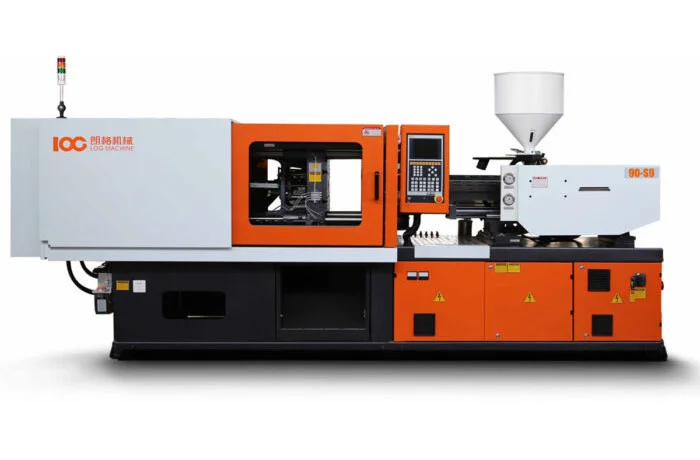
Every LOG S8 and S9 machine is quoted with a specified injection unit, not just a tonnage. The S8 uses a double-cylinder injection design for higher injection pressure with a simpler structure, and both series are available with different L/D configurations depending on what your material needs.
Send us your part volume, cavity count, resin, and cycle target through the application worksheet, and we will size both units rather than quoting you a tonnage and leaving the injection side to chance.
See the machines running
Our YouTube channel carries machine demonstrations across the S8 and S9 ranges, which is a reasonable way to see how these machines behave before you get into specifications.
After the sale
Spare parts for LOG machines are available through Virtus Equipment Direct, our online store. Our field service engineers are certification-trained, and we offer operator training and processing assistance, including mold tests and help with difficult engineering resins, because a correctly specified machine still has to be run correctly.
Frequently asked questions
What is the difference between shot size and shot capacity?
Shot size is the amount of material your part actually needs per cycle. Shot capacity is the maximum the machine’s injection unit can deliver. Your required shot size should sit within a sensible working band of the machine’s capacity, not at either extreme.
How do I calculate the shot size I need?
Multiply part volume by the number of cavities, add the volume of the sprue, runners, and gates, then add an allowance for packing and shrinkage compensation. People routinely forget the feed system, and they forget that moving from a single-cavity prototype tool to a production multi-cavity tool multiplies the requirement.
Is a bigger injection unit always safer?
No, and this is the part that surprises people. Running far below the machine’s shot capacity means material sits in the barrel longer at temperature, which degrades heat-sensitive resins and causes discolouration, black specks, and property loss. It also worsens shot-to-shot consistency. Oversizing the injection unit is a real failure mode, not a safety margin.
Why does barrel capacity not match my material?
Injection unit capacity is conventionally quoted against a reference material, typically polystyrene. If you run a filled nylon, PVC, or another resin, the effective capacity differs. Always adjust the figure for the material you will actually process rather than using the headline number directly.
Terms worth knowing
Shot size. The volume or weight of material required per cycle: part volume times cavities, plus the feed system, plus a packing and shrinkage allowance.
Shot capacity. The maximum volume the injection unit can deliver in a single shot, conventionally specified against a reference material such as polystyrene.
Residence time. How long material sits in the heated barrel before being injected. Excessive residence time degrades heat-sensitive resins, which is why running far below shot capacity is a problem rather than a safety margin.
Short shot. A part that is incomplete because insufficient material was delivered to fill the cavity. It is the classic symptom of undersized shot capacity.
Feed system. The sprue, runners, and gates. This material is delivered on every shot and must be counted in the shot size calculation even though it is not part of the product.