Buyers ask about tonnage. Occasionally they ask about shot size. Almost nobody asks about the screw, which is unfortunate, because the screw is where your material either melts properly or does not.
Everything downstream of a bad melt is compromised. You can have the correct clamping force, the correct shot capacity, a mold that fits perfectly, and still produce parts with unmelted granules, colour streaking, or property variation, because the material arriving at the mold was never properly homogenised in the first place.
What L/D actually means
L/D is the ratio of the screw’s length to its diameter. A screw described as 20:1 is twenty times as long as it is wide. It is a deceptively simple number that governs a great deal.
The screw does three jobs in sequence along its length: it conveys solid pellets from the hopper, it compresses and melts them, and it meters a homogeneous shot ready for injection. A longer screw relative to its diameter gives the material more time and more mechanical working to complete that sequence.
The practical consequences:
A higher L/D gives better mixing and more thorough melting. Material spends longer being worked, which produces a more uniform melt. This matters most with filled resins, colour concentrates, and anything where inconsistent melt shows up as a visible or structural defect.
A lower L/D means shorter residence time in the heated barrel. That is not a deficiency, it is a protection. Heat-sensitive materials degrade with prolonged exposure to temperature, and for those resins a shorter path through the barrel is the safer one.
Neither is universally better. The right L/D is a function of what you are running.
Screw type matters as much as ratio
Machines are conventionally quoted with a general-purpose screw unless someone asks otherwise, and that default is right for a great many applications. It is not right for all of them.
A general-purpose screw handles common thermoplastics such as PP, PE, PS, and ABS perfectly well. If you are molding buckets, crates, or household goods in a standard polyolefin, this is almost certainly what you want.
A mixing screw adds features that improve melt homogeneity. If you are running colour concentrate and seeing streaking, or working with a blend that needs thorough dispersion, the additional mixing capability earns its cost.
A barrier screw separates solid and melted material along the screw, which improves melting efficiency and melt consistency, particularly at higher outputs.
The mistake is not choosing the wrong screw. It is never being asked, taking the general-purpose default, and then spending months troubleshooting a melt problem in the process settings when the cause is in the hardware.
Which screw for which job
Three screw types cover most applications. The default is not always the right one, and the difference shows up in melt quality, not on the tonnage badge.
| Screw type | What it does best | Choose it when |
|---|---|---|
| General-purpose | Reliable melting of common thermoplastics | Running standard PP, PE, PS, or ABS (buckets, crates, household goods) |
| Mixing | Improved melt homogeneity and dispersion | Colour concentrate is streaking, or a blend needs thorough dispersion |
| Barrier | Separates solid and melted material for efficient, consistent melting | Running at higher outputs where melt consistency is critical |
And L/D governs how much working the material gets on the way through: a higher ratio for better mixing and thorough melting, a lower ratio to protect heat-sensitive resins with a shorter residence time.
Where LOG machines sit on this
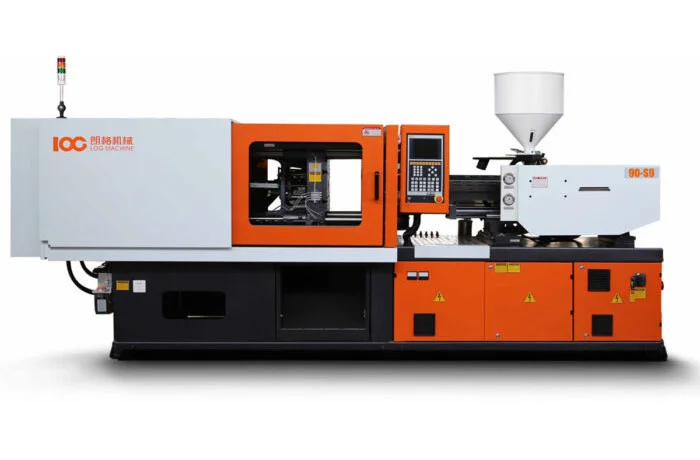
Our S8 is built around a highly adjustable L/D ratio, and the injection unit uses a bridge-style design specifically to accommodate different L/D plasticising parts. That is a deliberate design choice: the same machine platform can be configured for the material you actually run rather than forcing your material to suit a fixed screw.
A few other injection unit details that bear on melt quality:
The injection unit uses a double-cylinder design, which delivers higher injection pressure with a simpler structure and a lower malfunction rate. The enlarged twin-cylinder arrangement also prevents material leakage caused by machine vibration during high-speed nozzle operation, which is a real problem on lesser designs.
The injection cylinder uses low-friction seals to improve response rate and stability through complex injection profiles, and graphite bushings improve wear resistance while reducing lubrication oil usage, which keeps the injection area cleaner.
Screw diameter, and the trap in the spec sheet
Screw diameter and shot volume are related, and the relationship is not what people assume.
Take our S8 250 as a worked example. Its specification lists a screw diameter of 58 mm and a shot volume of 625 g in polystyrene. That PS qualifier is doing important work. Polystyrene is the conventional reference material for quoting injection capacity, and your resin is almost certainly not polystyrene.
If you run a filled nylon, that same screw delivers a different mass. If you run a low-density polyolefin, different again. Taking the headline shot figure and applying it directly to your material without adjustment is one of the quieter ways to end up with a machine that cannot deliver the shot you need.
The question to ask before you buy
Not “what tonnage do I need,” but: what resin am I running, and has anyone specified the screw for it?
If the answer is that a general-purpose screw was assumed and nobody asked what you were processing, that is worth a conversation before the machine is built rather than after it is installed.
Tell us your resin, your fillers if any, your colour requirements, and your shot size through the application worksheet. Our application engineers handle difficult-to-process engineering resins routinely, and specifying the screw correctly at the outset costs nothing.
See the machines running
Our YouTube channel carries machine demonstrations across the S8 and S9 ranges, which is a reasonable way to see how these machines behave before you get into specifications.
After the sale
Spare parts for LOG machines are available through Virtus Equipment Direct, our online store. Our field service engineers are certification-trained, and we offer operator training and processing assistance, including mold tests and help with difficult engineering resins, because a correctly specified machine still has to be run correctly.
Frequently asked questions
What is L/D ratio in an injection molding machine?
It is the ratio of the screw’s length to its diameter. A higher L/D gives more mixing and more thorough melting, which suits filled resins and colour concentrates. A lower L/D means shorter residence time in the heated barrel, which protects heat-sensitive materials from degrading. Neither is universally better; the right ratio depends on what you run.
Do I need a general-purpose screw or something else?
Machines are conventionally quoted with a general-purpose screw, which is right for common thermoplastics like PP, PE, PS, and ABS. A mixing screw improves melt homogeneity, which helps with colour streaking and blends needing dispersion. A barrier screw separates solid and melted material for better melting efficiency at higher outputs. The mistake is not being asked at all.
Why does the shot volume say PS on the spec sheet?
Polystyrene is the conventional reference material for quoting injection capacity. The LOG S8 250, for example, lists 625 g shot volume in PS with a 58 mm screw. If you run a filled nylon or a low-density polyolefin, the effective figure differs. Always adjust for the material you will actually process.
Can a LOG machine be configured for my specific resin?
Yes. The S8 is built around a highly adjustable L/D ratio, and the injection unit uses a bridge-style design specifically to accommodate different L/D plasticising parts. Tell us your resin, fillers, and colour requirements up front and the screw can be specified for the material rather than assumed.
Terms worth knowing
L/D ratio. The ratio of screw length to screw diameter. It governs how much time and mechanical working the material receives before injection.
General-purpose screw. The default screw specification, suitable for common thermoplastics such as PP, PE, PS, and ABS.
Barrier screw. A screw design that separates solid and melted material along its length, improving melting efficiency and melt consistency, particularly at higher outputs.
Mixing screw. A screw with additional features to improve melt homogeneity, useful with colour concentrates and blends requiring thorough dispersion.
Reference material. The material against which injection capacity is conventionally quoted, typically polystyrene. Capacity figures must be adjusted for the resin actually being processed.