Scrap is the quietest cost in a molding shop. Every rejected part carries the full material, machine, labor, and energy that went into it. Here’s where it comes from and how to cut it.
Scrap is the quietest cost in a molding operation. It does not show up as a line item the way electricity or resin does, but every rejected part carries the full cost of the material, the machine time, the labor, and the energy that went into making it, and then adds the cost of handling or reprocessing it. A shop running a few points of scrap higher than it needs to is leaving real money on the floor every shift. This is a practical guide to where scrap comes from and how to drive it down.
A scrapped part is not just wasted material. It is wasted machine time, labor, and energy too, all spent producing something you cannot sell. Cutting scrap rate improves yield, throughput, and cost per good part simultaneously. It is one of the highest-leverage improvements a molding operation can make.
Where scrap comes from
Molding scrap concentrates in a few sources, and naming them is the first step to reducing them.
| Source | Typical driver |
|---|---|
| Startup and changeover | Parts made while the process stabilizes before it’s in spec |
| Process drift | The machine wanders out of its window mid-run, producing defects |
| Defects | Sink, warp, short shots, flash, splay, each a rejected part |
| Material issues | Wet resin, contamination, or wrong lot causing bad parts |
| Runners and sprues | Necessary in cold-runner tools, but recoverable, not lost |
The four levers that cut scrap
1. Process stability
The biggest driver of steady-state scrap is a process that will not hold still. If temperature, pressure, and timing drift shot to shot, parts drift in and out of spec and the rejects pile up. The fix is a machine that holds its process window precisely and repeatably, shot after shot. This is a core reason servo-driven machines matter for yield: their precise, repeatable control keeps the process where you set it, so fewer parts wander out of tolerance.
2. Fewer, shorter startups
Every startup and changeover produces scrap while the process stabilizes. Two things help: reducing the number of startups through better production planning and reliability (an unplanned breakdown means another startup later), and shortening each startup by returning to known-good settings quickly. A machine that reaches stable operation fast wastes fewer parts getting there.
3. Material discipline
Wet resin and contamination are pure scrap generators, and both are preventable. Proper drying of hygroscopic resins, clean material handling, and lot control eliminate a whole category of defects before they reach the mold. Material problems are among the cheapest scrap sources to fix because the fix is procedural, not capital.
4. Reprocessing what you can
Not all scrap is loss. Runners, sprues, and startup parts of clean thermoplastic can often be reground and blended back into production, recovering much of their value instead of discarding it. This is where an injection molding operation and size-reduction equipment connect: a granulator turns in-house scrap into reusable regrind, so the material stays in your loop rather than leaving as waste. Clean, consistent regrind blended within your material’s limits displaces virgin resin you would otherwise buy.
What a scrapped part actually costs
A rejected part carries every input that went into it, not just the material. Illustrative breakdown of the embedded cost.
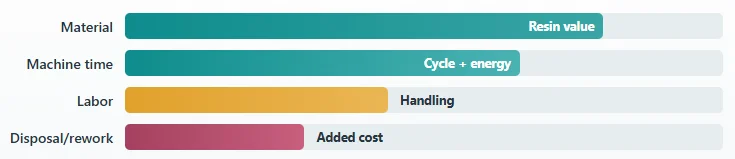
Illustrative composition of the embedded cost in a scrapped part. Exact proportions vary by part, material, and operation.
Measure it, then move it
You cannot reduce what you do not track. Start by measuring your scrap rate and, ideally, categorizing rejects by cause, startup, drift, specific defects, material, so you know where the scrap actually concentrates. Then attack the biggest category first. A shop that tracks recurring defect patterns instead of treating each reject as isolated finds the systemic causes and fixes them once, rather than re-solving the same problem every week.
Scrap is wasted material, time, labor, and energy combined. Cut it by holding a stable process, minimizing and shortening startups, keeping material clean and dry, and reprocessing what you can. Measure by cause and attack the biggest source first. Lower scrap improves yield, cost, and throughput all at once.
Frequently asked questions
What’s usually the biggest source of moldng scrap?
It varies by shop, but process drift and startup/changeover are common leaders in steady production, along with recurring defects. The only way to know your biggest source is to track rejects by cause. Whichever category dominates is where the fastest savings are.
How does machine choice affect scrap rate?
A machine that holds its process window precisely and repeatably produces fewer out-of-tolerance parts, and one that reaches stable operation quickly wastes fewer parts at startup. Both reduce scrap. Precise, repeatable control is a core reason servo machines help yield.
Can I reuse scrap parts and runners?
Often yes. Clean thermoplastic runners, sprues, and startup parts can be reground and blended back into production, recovering much of their value. A granulator turns that in-house scrap into reusable regrind, keeping the material in your loop instead of discarding it.
Want to push your yield higher?
LOG’s servo machines hold a stable process window, and our engineers help optimize your process to cut scrap. Better yield, lower cost per good part.