In a modern molding cell, the machine isn’t the only thing moving. Automation has gone from a luxury for the biggest shops to a practical tool at any scale, and it changes the economics.
Walk into a modern molding cell and the machine is often not the only thing moving. A robot lifts finished parts from the mold, sets them on a conveyor, maybe places an insert or trims a gate. Automation has moved from a luxury for the largest shops to a practical tool for operations of all sizes, and it changes the economics of molding in ways worth understanding whether or not you are ready to add it. This is a plain-language look at what automation does in injection molding, what it is good for, and how to think about adopting it.
The headline benefit of automation is not just labor savings, it is consistency. A robot removes every part the same way, at the same point in the cycle, every time. That repeatability tightens cycle time, protects part quality, improves safety, and frees skilled people for work that actually needs judgment.
What automation does in a molding cell
Automation in injection molding covers a range of tasks, from simple to sophisticated:
| Task | What it does |
|---|---|
| Part removal | A robot lifts parts from the mold as it opens, faster and more consistently than by hand |
| Sprue/runner handling | Separates and routes runners for regrind or disposal |
| Insert placement | Places metal or other inserts into the mold precisely for insert molding |
| Downstream operations | Trimming, assembly, labeling, packing, and quality inspection |
| Part stacking/packing | Orients and packs finished parts for shipment |
The four real benefits
1. Cycle-time consistency
Manual part removal is variable, an operator is faster on some cycles than others, and the machine often waits. A robot removes parts at the same moment every cycle, which lets you run a tighter, more predictable cycle. Since cycle time compounds across every shot of every shift, even a small, consistent improvement adds up to significant output over time.
2. Consistent quality
Automated handling reduces the part-to-part variation that human handling introduces, and it protects parts from handling damage and contamination, important for cosmetic, medical, and precision parts. Consistent removal also means consistent cooling and cycle timing, which feeds back into more consistent parts.
3. Safety
Removing the need for a person to reach into or near the mold area during operation is a genuine safety improvement. The clamp area of a molding machine is a hazardous zone; automation keeps people out of it during the cycle.
4. Labor leverage
Automation does not just replace labor, it redeploys it. Freed from repetitive part removal, skilled operators can run more machines, handle setup and quality work, and focus on tasks that need human judgment. For shops facing tight labor markets, that leverage can be the difference between running a cell and idling it.
Where automation adds the most value
Relative benefit of automation across common goals. Directional, higher for high-volume, precision, or labor-constrained operations.
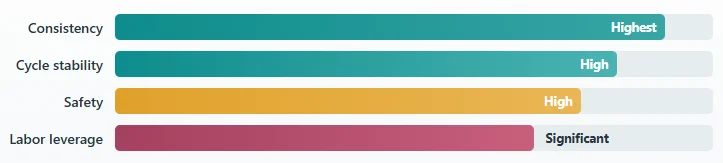
Directional view of where automation delivers value. Payback is strongest for high-volume, precision, or labor-constrained work.
Is automation right for your operation?
Automation is not automatic ROI for every job. It pays back fastest where volumes are high (so the consistency compounds), where parts are precision or cosmetic (so handling matters), where inserts or downstream steps are involved (so the robot does real work), and where labor is tight or expensive. For low-volume, high-mix work with frequent changeovers, the economics are more nuanced, though flexible automation is narrowing that gap. The honest first step is matching the automation to the job rather than automating for its own sake.
One foundation matters regardless: automation depends on a consistent, repeatable machine. A robot timed to a cycle only works if the cycle is stable shot to shot. The precision and repeatability of a servo-driven machine is what makes reliable automation possible, the two technologies reinforce each other.
Automation’s real product is consistency, in cycle time, in quality, and in safety, with labor leverage on top. It pays back fastest in high-volume, precision, or labor-constrained work, and it depends on a stable, repeatable machine underneath it. Match the automation to the job, and build it on a foundation that holds its process.
Frequently asked questions
Is automation only worth it for large operations?
No, though volume helps the payback. Automation pays back fastest in high-volume, precision, or labor-constrained work. Even smaller shops facing tight labor or making cosmetic and precision parts can benefit. The key is matching the automation to the specific job rather than automating for its own sake.
What’s the most common first step into automation?
Robotic part removal, a robot that lifts finished parts from the mold as it opens. It’s the most direct win: faster and more consistent than manual removal, safer because it keeps people out of the clamp area, and it stabilizes cycle time. Many operations expand from there.
Does automation require a specific kind of machine?
It requires a consistent, repeatable one. A robot timed to the cycle only works reliably if the cycle is stable shot to shot. The precision and repeatability of a servo-driven machine is what makes dependable automation possible, so the two work best together.
Thinking about automating a cell?
Automation needs a stable, repeatable machine underneath it. LOG’s servo machines provide that foundation, and our engineers can help you plan the integration.