There is a particular kind of silence that falls over a plant when a new machine arrives, the mold is brought over on a forklift, and it becomes apparent that it is not going to fit.
It happens. Not often, but often enough, and always for the same reason: the machine was specified on tonnage, and tonnage tells you nothing whatsoever about whether your mold will physically go into the space between the platens.
These are the dimensions to check before you sign anything.
Tie-bar spacing
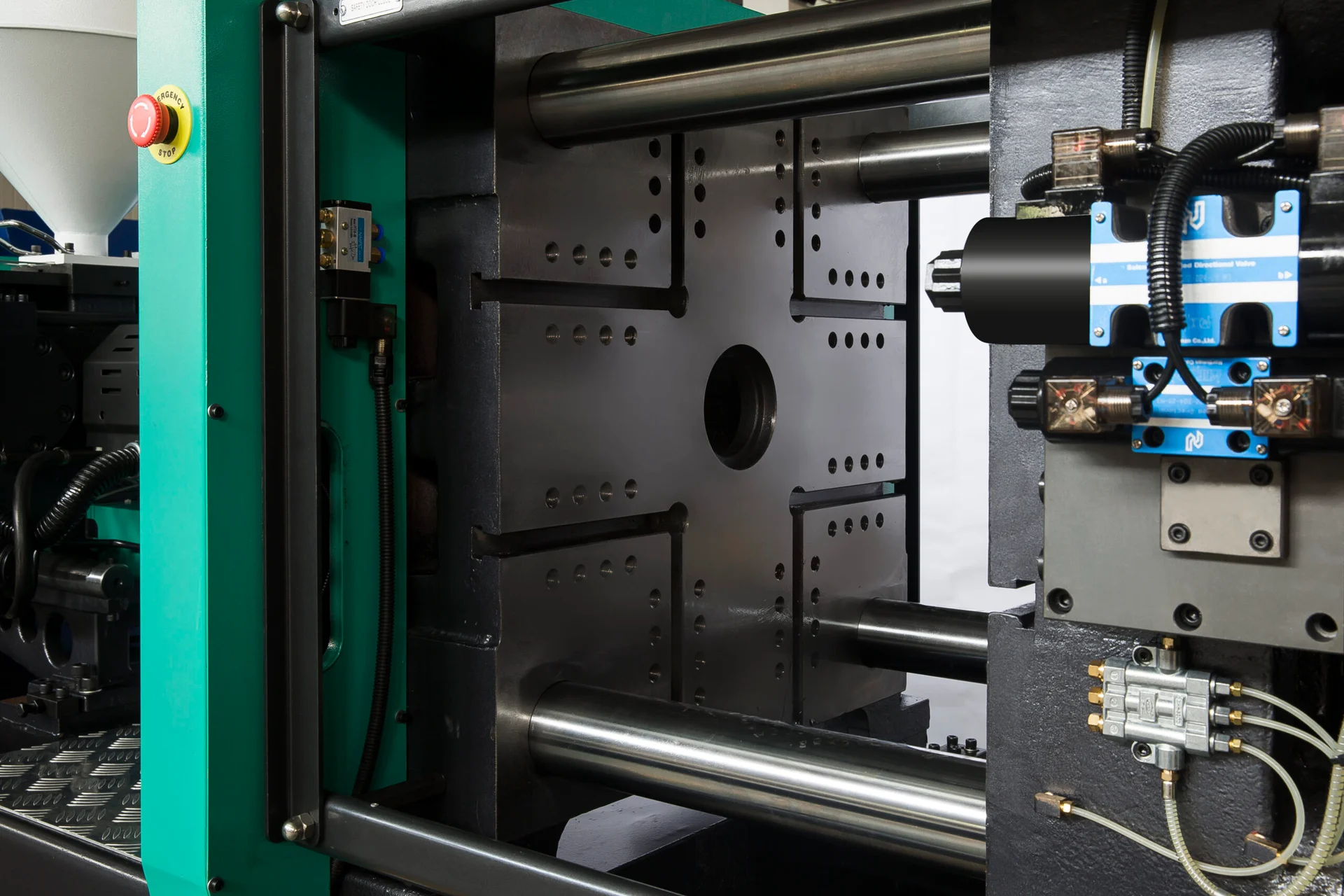
The tie bars are the four columns that carry the clamping load between the platens. The horizontal and vertical distance between them defines the opening your mold has to pass through.
Your mold must physically fit between them, and the check is not simply width against width. Molds are loaded from the side or lifted in from above, and the base of the mold, its clamping plates, and anything protruding from it all have to clear the bars. A mold that fits on paper can be unloadable in practice.
If a mold is close to the tie-bar limit, that is worth raising before purchase rather than discovering on the day. Sometimes the answer is a wider machine at the same tonnage.
Mold height, minimum and maximum
Two numbers, and people usually only look at one.
Maximum mold height is intuitive: the machine cannot close on a mold thicker than it can accommodate.
Minimum mold height is the one that catches people out. A machine has a lower limit as well, and if your mold is thinner than that minimum, the machine cannot generate clamping force against it properly. The toggle geometry needs to be within its working range to develop the force it is rated for. Too thin a mold and you are not clamping correctly, whatever the tonnage on the badge says.
Both limits matter, and if you run a variety of tooling, the machine has to accommodate the whole range, not just your current job.
Clamp stroke and daylight
Clamp stroke is how far the moving platen travels. Daylight is the maximum opening between platens with the machine fully open.
These determine whether your part can actually get out. A deep part, a tall core, or a part that needs a long ejection stroke all require the mold to open far enough for the part to clear the tooling and drop or be removed. It is entirely possible to have adequate tonnage, adequate shot capacity, a mold that fits between the tie bars, and still be unable to eject the part because the machine does not open far enough.
If you are molding buckets, crates, containers, or anything with real depth, this is not a detail. It is a primary specification.
Platen dimensions
The platens must support the mold, and the mold must be clampable to them. Check the platen size against your mold’s footprint and confirm the clamping slot or bolt pattern will actually work with your mold’s clamping arrangement.
Ejection
Ejector pattern and stroke need to match your tooling. LOG machines use SPI pattern ejection, which is the common standard in North American tooling, but the stroke still has to be long enough to push your part clear.
The checklist, plainly
Six specifications decide whether a mold fits, and each one fails in its own way if you skip it. Here they are together.
| Specification | What it controls | What goes wrong if it is off |
|---|---|---|
| Tie-bar spacing | Whether the mold passes between the bars | Mold will not physically load into the machine |
| Maximum mold height | Thickest mold the machine can close on | Machine cannot close on the mold |
| Minimum mold height | Thinnest mold the toggle can clamp properly | Full clamping force is never developed, whatever the badge says |
| Clamp stroke & daylight | How far the machine opens for part removal | Deep parts cannot clear the tooling to eject |
| Platen dimensions | Support and clamping of the mold footprint | Mold cannot be securely clamped to the platen |
| Ejector pattern & stroke | Match to tooling and push-out distance | Ejectors do not align or cannot push the part clear |
1. Tie-bar spacing, horizontal and vertical, with loading clearance
2. Maximum mold height
3. Minimum mold height
4. Clamp stroke and daylight, sufficient to eject your deepest part
5. Platen dimensions and clamping arrangement
6. Ejector pattern and stroke
None of these is exotic. All of them are on the specification sheet. The failure is not that the information is unavailable, it is that tonnage crowds everything else out of the conversation.
Why the platen design itself matters
One point specific to our machines, and it bears on this topic directly. Under clamping load, platens deflect. That deflection is not uniform, it concentrates, and over time it is what causes uneven clamping, flash on one side of a part, and accelerated wear on the mold.
The LOG S8 uses a third-platen flange design, where the flange and tie bar work together to generate a reverse torque that counteracts the deformation of the third platen under pressure. The first clamping platen uses a box-type structure with increased thickness for the same reason: to resist the deflection that tie-bar force induces.
The practical benefit is not on any spec sheet. It shows up as a mold that stays flat under load, and a mold that lasts longer because it is not being repeatedly stressed unevenly.
Send us the mold drawing
The simplest way to avoid all of this is to give us the mold dimensions rather than a tonnage. Send them through the application worksheet, and we will confirm fit against the S8 and S9 ranges before anything is quoted, let alone shipped.
Checking a drawing costs nothing. Discovering the problem on the plant floor costs a great deal.
See the machines running
Our YouTube channel carries machine demonstrations across the S8 and S9 ranges, which is a reasonable way to see how these machines behave before you get into specifications.
After the sale
Spare parts for LOG machines are available through Virtus Equipment Direct, our online store. Our field service engineers are certification-trained, and we offer operator training and processing assistance, including mold tests and help with difficult engineering resins, because a correctly specified machine still has to be run correctly.
Frequently asked questions
What is tie-bar spacing and why does it matter?
Tie bars are the four columns carrying the clamping load between platens. The horizontal and vertical distance between them defines the opening your mold must pass through. It is not just a width check: the mold, its clamping plates, and anything protruding must clear the bars during loading, which is why a mold that fits on paper can be unloadable in practice.
Why is there a minimum mold height as well as a maximum?
Because the toggle geometry needs to be within its working range to develop the clamping force the machine is rated for. If your mold is thinner than the machine’s minimum, you are not clamping properly regardless of the tonnage on the badge. Most buyers check the maximum and never look at the minimum.
What is daylight, and why does it matter for deep parts?
Daylight is the maximum opening between platens with the machine fully open, and clamp stroke is how far the moving platen travels. Together they determine whether a deep part can clear the tooling and be ejected. You can have correct tonnage, correct shot capacity, and a mold that fits, and still be unable to get the part out.
What should I send you to check that my mold will fit?
The mold dimensions, not a tonnage. Tie-bar clearance, mold height, required stroke, platen footprint, and ejector arrangement. We will confirm fit against the S8 and S9 ranges before quoting. Checking a drawing costs nothing; discovering the problem on the plant floor does not.
Terms worth knowing
Tie bars. The four columns that carry the clamping load between the platens. The spacing between them defines the opening a mold must pass through.
Mold height. The thickness of the closed mold. Machines have both a maximum and a minimum, and the minimum is the one buyers overlook.
Daylight. The maximum opening between platens with the machine fully open, which governs whether a deep part can be ejected clear of the tooling.
Clamp stroke. How far the moving platen travels between fully closed and fully open.
Platen deflection. The bending of the platens under clamping load. Uncontrolled, it causes uneven clamping, flash, and accelerated mold wear, which is why platen structure and the third-platen flange design matter.