Recycled resin is no longer a niche experiment. It is a mainstream requirement, and running it well is a processing skill. Here is what recycled plastics ask of your machine, and where they fit without hurting your parts.
Manufacturing is shifting from a linear “take, make, dispose” model toward a circular one, and injection molding sits right at the center of that change. For plant managers and engineers, the challenge is adopting recycled materials without compromising the mechanical integrity or dimensional stability of the finished part. The pressure is not only from customers: in the United States, environmental rules for 2026 call for a meaningful increase in the use of post-consumer recycled (PCR) resins, pushing manufacturers to balance structural performance against a smaller environmental footprint.
This article separates the types of recycled plastic, explains what each one does on the machine, and lays out where recycled resin belongs, and where it does not yet.
Know your feedstock: PCR vs. PIR vs. regrind
“Recycled plastic” is not one thing. The three streams behave very differently on the press, and the difference comes down to consistency.
| Stream | What it is | Consistency | Best fit |
|---|---|---|---|
| Regrind (in-house) | Scrap from your own molding, such as sprues and runners, shredded and fed back in. | High — you know its exact history. | Blending back into the same job at a controlled ratio. |
| PIR Post-Industrial Recycled |
Clean manufacturing scrap from industrial streams, reclaimed before it ever reached a consumer. | More consistent than PCR — controlled source. | Structural and semi-cosmetic parts needing predictable properties. |
| PCR Post-Consumer Recycled |
Material from end-user products such as bottles and packaging, diverted from landfill, cleaned, and re-pelletized. | More variable — depends on consumer use, sorting, and contamination. | Housings, covers, brackets, non-cosmetic internal parts. |
Because reheating and re-molding alter a plastic’s physical performance, regrind can no longer be considered a virgin material. A common practice is to blend virgin resin with recycled at around a 75:25 ratio to offset the drop in performance, though the right ratio is application-specific.
What recycled resin asks of your machine
Running recycled material is a genuine processing skill, not a drop-in swap. Two adjustments come up repeatedly:
- PCR often needs re-stabilization. Additives are frequently required to bring PCR’s impact strength back up toward that of virgin resin, because each heat history degrades the polymer a little further.
- Biodegradable resins are heat-sensitive. Materials such as PLA and PHA are shear-sensitive and need lower melt temperatures to avoid degrading during the shot, which places a premium on precise temperature and shear control.
Recycled and bio-based resins also carry different thermal profiles than virgin ABS or PC, so molds and processes often need adjusted venting and gate placement to run them cleanly. This is precisely where a precise, repeatable servo machine earns its keep: consistent, on-demand control of injection speed, pressure, and melt temperature is what keeps a variable feedstock producing consistent parts.
The payoff: a real carbon reduction
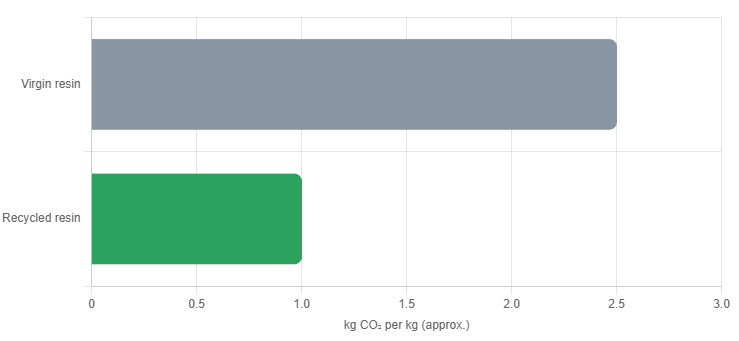
The environmental case is concrete. Virgin plastics emit roughly 2 to 3 kg of CO₂ per kg during production. Recycled plastics can cut that by up to 60%, often down to about 0.8 to 1.2 kg of CO₂ per kg, largely by avoiding raw-material extraction.
One myth worth retiring: recycled is not always cheaper
It is easy to assume recycled resin is the budget option, but that is not reliably true. The price of recycled resin depends on the polymer, grade, color, source, certification requirements, regional supply, and current virgin-resin prices. High-quality PCR can cost as much as, or more than, a comparable virgin grade because of the collection, sorting, cleaning, testing, compounding, and traceability required to produce it.
Prices also move quickly. In May 2026, S&P Global reported that several recycled PET and polyethylene benchmarks had shifted from their historical premiums to discounts as virgin-resin prices rose faster. The takeaway: build the business case on current supplier pricing and total cost per acceptable part, not on the assumption that recycled always costs less.
Where recycled plastics fit today
Recycled resin is a strong fit when the mechanical and appearance requirements are reasonable: covers, housings, brackets, and non-cosmetic internal components are natural candidates. Real-world examples already in production include consumer-electronics housings using PC/ABS blends with 30 to 50% PCR content, and agricultural products such as biodegradable pots and clips. The success factor throughout is quality control: documentation, consistent lots, and incoming checks that keep the process stable and the part within spec.
Key terms
- PCR (Post-Consumer Recycled)
- Plastic recovered from end-user products such as bottles and packaging, then cleaned and re-pelletized. More variable than industrial scrap because of consumer use and contamination.
- PIR (Post-Industrial Recycled)
- Clean manufacturing scrap reclaimed before it ever reached a consumer. More consistent than PCR because its source is controlled.
- Regrind
- In-house scrap such as sprues and runners, shredded and fed back into the same job, usually blended with virgin resin at a controlled ratio.
- Re-stabilization
- Adding stabilizer additives to recycled resin to restore properties like impact strength that degrade with each heat history.
- Closed-loop system
- A production setup that recycles its own waste back into the process, minimizing landfill and virgin-material use.
Frequently asked questions
Can you injection mold with 100% recycled plastic?
It depends on the part and the resin. Recycled material often needs re-stabilization additives to recover properties, and because each heat history degrades the polymer, many applications blend virgin with recycled (a common starting point is around 75:25) rather than running 100% recycled. Non-cosmetic parts such as housings, covers, and brackets are the strongest candidates for high recycled content.
Is recycled plastic cheaper than virgin resin?
Not always. High-quality PCR can cost as much as or more than a comparable virgin grade because of the collection, sorting, cleaning, testing, and traceability required to produce it. Prices also move quickly relative to virgin resin. Build the business case on current supplier pricing and total cost per acceptable part, not on the assumption that recycled always costs less.
How much CO2 does recycled plastic save?
Virgin plastics emit roughly 2 to 3 kg of CO2 per kg during production. Recycled plastics can cut that by up to about 60%, often down to roughly 0.8 to 1.2 kg per kg, mainly by avoiding raw-material extraction. Actual figures vary by polymer and process.
What is the difference between PCR and PIR plastic?
PIR (post-industrial recycled) is clean manufacturing scrap reclaimed before reaching a consumer, so it tends to be more consistent. PCR (post-consumer recycled) comes from used end products and is more variable due to consumer use, sorting, and contamination. PIR is often preferred for parts needing predictable properties; PCR carries the stronger sustainability story.
Do recycled plastics require changes to the molding process?
Often yes. PCR may need re-stabilization additives, and biodegradable resins like PLA and PHA are shear-sensitive and need lower melt temperatures. Recycled and bio-based resins can also carry different thermal profiles than virgin resin, so venting and gate placement may need adjustment. Consistent, precise machine control and incoming material checks are what keep a variable feedstock producing consistent parts.
Build your closed-loop line
Browse injection molding machines, granulators, and spare parts for recycling operations directly through our online portal, or see the equipment at work.