Most unplanned press stoppages are not bad luck. They are a maintenance task that was skipped weeks earlier. Here is the layered schedule that catches problems before they cost you a shift.
A plastic injection molding machine is a system of hydraulic, electrical, thermal, and mechanical parts that all have to stay in sync. When one part drifts out of spec, the failure tends to cascade into the others, which is exactly why a small, cheap problem such as contaminated hydraulic oil or a weeping hose turns into scrap parts, an emergency repair, and lost production time. The good news is that the failures that cause the most downtime are also the most predictable, and a structured schedule is what turns them from surprises into planned five-minute tasks.
The cost of getting this wrong is not abstract. Published industry figures put unplanned downtime in manufacturing environments at roughly $5,000 per hour, and a single major hydraulic failure can exceed $30,000 and multiple days of lost production once you add the emergency repair to the idle line around it. A maintenance program is one of the few investments on the plant floor that pays for itself the first time it prevents a single one of those events.
The maintenance schedule at a glance
Effective preventive maintenance is layered: quick daily checks catch the obvious, and progressively deeper inspections at weekly, monthly, quarterly, and annual intervals catch the wear that builds up slowly. The table below is the backbone. Treat the intervals as starting points and always defer to your machine’s operating manual and the recommendations of your service engineer.
| Interval | Focus | Representative tasks |
|---|---|---|
| Daily | Visual & safety | Check hydraulic oil level at the sight glass before start-up; scan cylinders, hoses, and fittings for leaks; clear scrap and spills from around the machine; confirm safety interlocks function. |
| Weekly | Lubrication & cleanliness | Lubricate tie bars, toggle mechanism, and ejector pins per the lubrication chart; inspect and clean mold cavities of plastic buildup; check hoses for abrasion and weeping. |
| Monthly | Clamp, platen & safety | Inspect toggle linkage pins and bushings for wear; verify machine level and platen parallelism to the moving platen; re-tap and mark damaged platen holes; test safety circuits. |
| Quarterly | Hydraulic health | Sample hydraulic oil for particulate contamination; change high-pressure filters and clean tank breathers; verify clamp tonnage and hold-pressure repeatability across several consecutive cycles. |
| Annual | Deep inspection | Pull and measure the screw against baseline dimensions; inspect tie-bar nuts and pre-stress; calibrate thermocouples and temperature controllers; check control-cabinet wiring for aging insulation. |
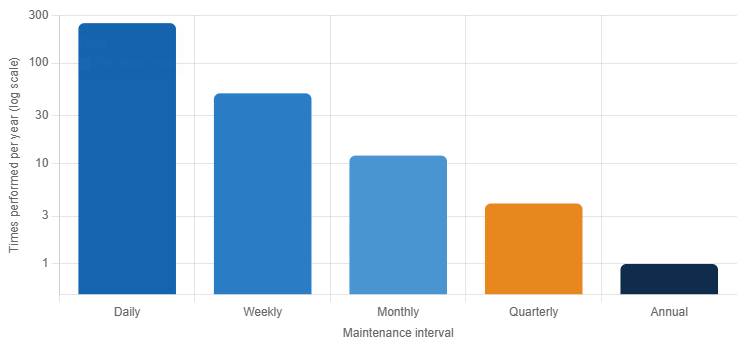
How maintenance frequency scales through the year
Illustrative task frequency per press per year at each interval, assuming a two-shift operation. Actual counts scale with your run hours and shot count.
Hydraulic oil: the interval people argue about
The hydraulic system is the heart of a servo-hydraulic or hydraulic press, and oil is the one consumable where you will find the widest range of published advice. That is because the right answer genuinely depends on run hours, oil temperature, and how clean you keep the system. Here is what the sources converge on:
- Check the level daily at the sight glass, and keep it between the minimum and maximum marks.
- Watch the temperature. Operating above roughly 140°F (60°C) degrades oil faster and stresses seals.
- Sample and analyze every 3 to 6 months to catch particulate contamination and water ingress before they reach the pump and valves. A common cleanliness target is to change oil once it exceeds an ISO 4406 rating of about 19/16/13.
- Change on a schedule. Published intervals range from every 4,000 to 8,000 operating hours or annually, to a broader 12 to 18 month window, to as long as 5,000 hours or yearly. The wide range is real, which is why oil analysis matters more than any single number.
- Break in new machines separately. Drain the hydraulic oil after the first few months on a brand-new press to flush out metal particles and contaminants introduced during break-in, then clean the valves, lines, and tank before refilling.
Why cycle-count triggers beat the calendar
The mold and the machine both wear as a function of how many shots they run, not how many days have passed on a wall calendar. A mold PM interval that makes sense at 10,000 cycles for one job may be far too long for another that runs at three times the rate. Tracking cumulative shot count and tagging each mold with its cycle count, last service date, and next-due date is what keeps a heavily-loaded machine from silently running past its safe interval. Many shops now use a maintenance system to trigger PM automatically off shot count so no interval gets missed or guessed.
The failure patterns a schedule is designed to catch
It helps to remember why each task is on the list. The highest-downtime, highest-risk failures in an injection molding operation are well understood:
- Hydraulic seal leaks and pressure loss — caught early by weekly level checks and quarterly oil analysis, before seals fail completely and cause slow clamping or inconsistent injection speed.
- Screw and barrel wear — revealed by annual screw-pull inspections measured against baseline data, so abrasive materials do not push wear past the point where leakage flow forces an emergency shutdown.
- Heater band failures and temperature drift — found by regular temperature-probe testing that identifies bands creating hot or cold spots.
A printable quick-reference checklist
Daily (each start-up)
- Hydraulic oil level at sight glass
- Visual leak scan: cylinders, hoses, fittings
- Clear scrap, spills, and debris around the press
- Confirm safety interlocks and guards operate
Weekly
- Lubricate tie bars, toggle, ejector pins
- Clean mold cavities and vents
- Inspect hoses for abrasion / weeping
Monthly
- Check machine level and platen parallelism
- Inspect toggle pins and bushings for wear
- Test safety circuits and limit switches
Quarterly
- Sample and analyze hydraulic oil
- Change high-pressure filters; clean breathers
- Verify clamp tonnage and hold-pressure repeatability
Annual
- Pull and measure screw against baseline
- Inspect and torque tie-bar nuts to spec
- Calibrate thermocouples and controllers
- Inspect control-cabinet wiring insulation
If you would rather have this done by a certified engineer than schedule it in-house, that is exactly what LOG’s after-sales program exists for. Our field service engineers are trained and certified specifically on LOG machines, and our training courses cover maintenance and machine optimization on current and older models alike.
Key terms
- Preventive maintenance (PM)
- Scheduled inspection and service performed to prevent failures, as opposed to reactive repair after a breakdown.
ISO 4406 cleanliness code- A three-number rating (for example 19/16/13) describing how many particles of given sizes are in hydraulic oil. Lower numbers mean cleaner oil.
Shot count / cycle count- The cumulative number of molding cycles a machine or mold has run. Used to trigger maintenance by actual use rather than by the calendar.
Tie bars- The large rods that guide the moving platen and carry the clamping load. They need periodic lubrication and inspection.
Platen parallelism- How square the moving and stationary platens are to each other. Loss of parallelism causes uneven clamp force and flash.
Frequently asked questions
How often should I change the hydraulic oil in an injection molding machine?
Published intervals vary widely, from roughly every 4,000 to 8,000 operating hours or annually, to a broader 12 to 18 month window, depending on the source and the machine. Because the right interval depends on run hours, oil temperature, and cleanliness, the most reliable approach is to sample and analyze the oil every 3 to 6 months and change it when contamination exceeds spec rather than relying on a fixed date. Always follow your machine’s operating manual.
Should maintenance be scheduled by calendar date or by machine usage?
By usage wherever possible. A press running three shifts wears far faster than one running a single shift, so triggering maintenance by actual shot count and operating hours prevents both wasteful early service and dangerous late service. Tag each mold with its cycle count, last service date, and next-due date.
What is the most common cause of unplanned injection molding downtime?
Hydraulic problems are among the most common and costly, especially seal leaks and pressure loss from contaminated oil. These are also among the most preventable, caught early by daily oil-level checks and quarterly oil analysis before they cascade into pump or valve damage.
How much does injection molding downtime cost?
Published industry figures put unplanned downtime in manufacturing environments at roughly $5,000 per hour, and a single major hydraulic failure can exceed $30,000 once you add the emergency repair to the idle production around it. That is why a structured maintenance program typically pays for itself the first time it prevents one event.
Do servo injection molding machines need less maintenance?
Servo machines like LOG’s S8 and S9 Series draw hydraulic power only on demand, which reduces heat load on the oil and can extend its life. This does not eliminate hydraulic maintenance, but it tends to make the oil’s job easier, especially when the machine is idling between shots.
Keep your press running
Order genuine spare parts and consumables directly, or watch our machines in action to see what a well-maintained LOG press delivers.