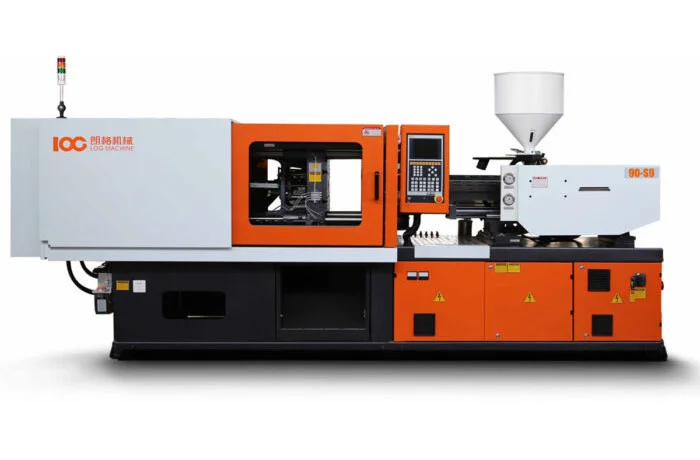
The pump on a conventional fixed-speed hydraulic press runs at full speed continuously throughout the production cycle, regardless of what the machine is actually doing at any given moment. During mold cooling, dwell time, and other non-active phases, the motor keeps drawing close to full power. You are paying for energy the machine is not using to produce anything.
Research published in the Journal of Cleaner Production found that electrical energy accounts for 30 to 45 percent of total operational costs in a serial injection molding cell. That makes electricity one of the most significant controllable cost variables in your operation, and it is one where drive technology makes a direct, measurable difference every shift the machines run.
How the Energy Gap Actually Looks
The chart below shows representative energy consumption by drive type, based on published industry data. The numbers come from research referenced in Plastics Technology, materials science publications, and manufacturer testing data.
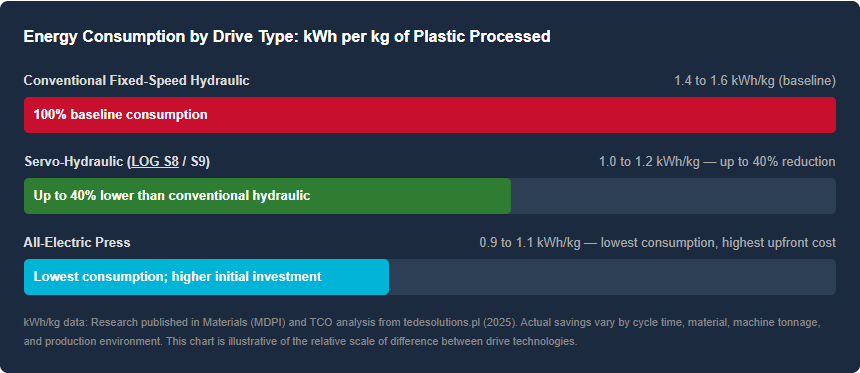
The mechanism behind the servo-hydraulic savings is straightforward. The servo motor adjusts its output in real time based on what the machine needs at each phase of the cycle. During cooling, the motor idles. During injection, it responds immediately with the required pressure and speed. You pay for power when work is being done, not continuously through phases where no work is occurring.
What the Published Data Shows
| Drive Technology | Avg. Energy Consumption | Reduction vs. Conventional Hydraulic |
|---|---|---|
| Conventional fixed-speed hydraulic | 1.4 to 1.6 kWh per kg produced | Baseline |
| Servo-hydraulic (variable displacement pump) | 1.0 to 1.2 kWh per kg produced | Up to 40% reduction |
| All-electric | 0.9 to 1.1 kWh per kg produced | Up to 50% reduction, higher upfront cost |
Source: Research published in Materials (MDPI); TCO and Energy Efficiency of Injection Molding Machines, tedesolutions.pl (2025).
What Else Changes With a Servo Press
Energy is the headline benefit, but it is not the only thing that improves. Servo-hydraulic presses run cooler because the hydraulic oil is not continuously agitated by a full-speed pump. Cooler oil means longer fluid service life, less heat rejection into the factory environment, and a more comfortable floor for operations running many presses close together.
Process control precision also improves. The servo motor responds quickly and consistently to control commands, which means injection speed, pressure, and position profiles execute more precisely shot to shot. For applications where part dimensional consistency directly drives quality or scrap rate, that is a meaningful advantage beyond the energy bill.
A Practical Approach to Press Replacement
Most shops do not replace their entire press fleet at once, and they should not have to. A practical approach is to identify the presses running the most hours, where the energy savings are largest, and where replacement is already on the horizon due to age or maintenance costs.
- Identify your highest-run-time presses and estimate their current electricity cost per year based on cycle time, tonnage, and operating hours.
- Compare that against projected consumption on a comparable servo-hydraulic LOG press using the kWh/kg data as a guide.
- Factor in maintenance cost trends on aging hydraulic presses versus a new press under warranty and service program.
- Build the total cost of ownership comparison over five and ten years, not just on purchase price.
- Contact LOG IMM to discuss tonnage, configuration, and delivery lead time for your highest-priority replacement.
Explore the LOG S8 Series Explore the LOG S9 SeriesShop Virtus Equipment Direct