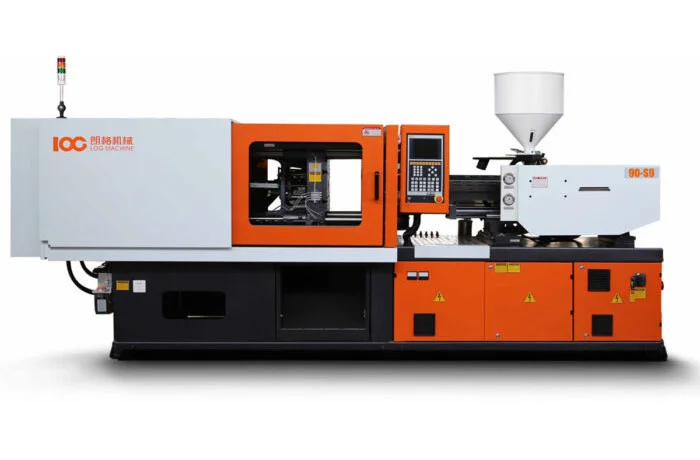
Look closely at any tonnage on our site and you will find an asterisk next to it. LOG S8 90 Ton*. LOG S8 250 Ton*. It is easy to skim past, and it is the single most consequential footnote in the entire specification.
The tonnage in a LOG model number is stated in metric tons, and a metric ton is roughly 1.1 US tons. A machine badged 250 is delivering about 275 US tons of clamping force. If you sized your part against US tons and bought against metric tons, or the reverse, you have introduced a ten percent error into the one specification that determines whether your parts come out right.
Ten percent sounds survivable. It is not.
Clamping force is not a comfort spec that you round to the nearest convenient number. It is the force holding your mold shut against the pressure of molten plastic trying to push it open. There is a threshold, and you are either above it or below it.
Below it, the mold separates fractionally during injection and plastic escapes into the parting line. That is flash. It shows up as scrap, as secondary trimming operations you did not budget for, and as a mold that is being repeatedly stressed in a way it was not designed for.
Well above it, you have paid for a larger machine than the job requires, and you will keep paying for it in energy and floor space for as long as you own it. Overclamping also does the mold no favours.
Ten percent is exactly the margin that turns a correctly sized machine into a marginal one. It is enough to put you under the threshold on a job you priced as comfortable.
Where the error actually does its damage
We have written separately about how to choose the right tonnage, and that piece walks through the calculation itself. This post is about what happens after you have done that calculation correctly and then apply it to the wrong unit.
The conversion error is most dangerous precisely where your margin is thinnest. If you are molding a chunky, forgiving part in a free-flowing polyolefin, ten percent of headroom probably still leaves you above the threshold. But thin-walled parts need high injection pressure to fill before the material freezes, and filled engineering resins demand more clamping pressure per square inch than a spec sheet’s typical figures suggest. In those applications you were already sizing close to the line, and ten percent is the difference between a machine that holds and a machine that flashes.
Put plainly: the harder your part is to mold, the more the unit matters.
The S8 range in both units
| Model | Metric tons | Approx. US tons |
|---|---|---|
| LOG S8 90 | 90 | ~99 |
| LOG S8 130 | 130 | ~143 |
| LOG S8 160 | 160 | ~176 |
| LOG S8 210 | 210 | ~231 |
| LOG S8 250 | 250 | ~275 |
| LOG S8 320 | 320 | ~352 |
| LOG S8 400 | 400 | ~440 |
| LOG S8 500 | 500 | ~550 |
| LOG S8 650 | 650 | ~715 |
US tons are approximate, at 1.1 per metric ton. For a purchase decision, work from the full specification on the individual machine page rather than from a rounded conversion.
Why we print the asterisk instead of quietly converting
It would be easy to publish US-ton badges and avoid the conversation entirely. We do not, for a straightforward reason: the machines are built and specified in metric, and every other figure on the spec sheet, shot size, platen dimensions, tie bar spacing, follows from that. Publishing one number in a different unit system than all the others is how errors get introduced rather than avoided.
The asterisk is there because we would rather you notice the unit than trust a conversion you did not make yourself.
Not sure what your part actually needs?
Sizing clamping force from a drawing is straightforward in principle and easy to get wrong in practice, particularly with thin walls, filled resins, or multi-cavity tools. Our application engineers do this calculation for a living, and they will do it with you rather than sell you the machine at the top of your budget.
Send us your part details through the application worksheet, or talk to us directly. We would rather size it correctly the first time than sell you a machine you will resent in eighteen months.
See the machines running
Our YouTube channel carries machine demonstrations across the S8 range, which is a reasonable way to see how these machines actually behave before you get into specifications.
After the sale
Spare parts for LOG machines are available through Virtus Equipment Direct, our online store. Our field service engineers are certification-trained, and we offer operator training and processing assistance, including mold tests and help with difficult engineering resins, because a correctly sized machine still has to be run correctly.
Frequently asked questions
Is LOG tonnage metric or US tons?
Metric. The number in the model name is metric tons, and one metric ton is approximately 1.1 US tons. An S8 250 therefore delivers roughly 275 US tons of clamping force. This is flagged with an asterisk on every product page precisely because it matters.
What happens if I undersize the clamping force?
The mold opens fractionally under injection pressure and plastic escapes into the parting line, which is flash. You get scrap, unplanned trimming operations, and repeated stress on a mold that was not designed to take it. A ten percent error is easily enough to cause this.
Is it safer to just buy extra tonnage?
Only up to a point. Sensible headroom is good practice. Buying a class or two above what you need means paying for capacity you will never use, in purchase price, energy, and floor space, for the entire life of the machine. Right-sizing beats over-buying.
How do I calculate what I actually need?
Take the projected area of the part on the parting line, including all cavities and runners, and multiply by the clamping pressure your resin requires, then add a margin. Thin walls and filled resins push the number up. If you would rather not do it alone, our application engineers will run it with you.
Terms worth knowing
Clamping force. The force holding the mold closed against the pressure of injected material. It is the primary sizing specification for an injection molding machine, and it is the one you cannot afford to guess at.
Projected area. The area of the part as seen looking down the axis of mold closure, the shadow it casts on the parting line. All cavities and runners count toward it.
Flash. Plastic that escapes into the parting line when clamping force is insufficient to hold the mold shut. It is the direct symptom of undersizing.
Metric ton. 1000 kilograms, approximately 1.1 US tons. LOG model tonnages are stated in metric tons.
Tons per square inch. The clamping pressure a given resin requires, which varies by material and by how hard the part is to fill.