Ask a buyer about tonnage and they have an answer ready. Ask about injection pressure and the conversation usually stops, which is odd, because pressure is the force that actually puts plastic into your mold. Tonnage keeps the mold shut. Pressure fills it. They are not the same job, and the machine does not do them with the same setting.
There is a further split inside pressure itself that trips up more processes than almost anything else on the setup sheet: the pressure that fills the part and the pressure that packs it are two different phases, controlled separately, and doing different work. Confuse them and you spend days adjusting one to fix a defect caused by the other.
Fill pressure and pack pressure are two phases, not one
A shot happens in stages. First the screw drives forward and pushes melt into an empty cavity: that is the filling phase, and the pressure driving it is injection pressure in the strict sense. Its job is to get material to the far corners of the mold before the melt front freezes off. Then, once the cavity is essentially full, control switches over and a second, usually lower pressure takes over to compensate for the shrinkage that happens as the plastic cools: that is holding pressure, sometimes called pack or hold.
The moment control switches from the first to the second is the transfer point, and it is important enough that we have given it its own post later in this series. For now the thing to hold onto is that these are distinct phases with distinct purposes.
Fill pressure is about getting there. Hold pressure is about staying full while it shrinks. A part can fill perfectly and still finish badly if the hold is wrong, and it can be packed beautifully and still short-fill if the injection phase never got material to the end of the cavity.
What each phase controls
Because the two phases do different work, they fail in different ways, and the defect on the bench tells you which phase to look at.
| Phase | What it controls | Too little | Too much |
|---|---|---|---|
| Injection (fill) | Getting melt to the end of the cavity before it freezes | Short shots, poor surface, incomplete fill | Flash, stress, mold pushed open |
| Holding (pack) | Compensating for shrinkage as the part cools | Sink marks, voids, low part weight, dimensional drift | Over-packing, flash, ejection stress, internal stress |
The practical value of the table is diagnostic. A sink mark is a holding problem, not a fill problem, and turning up injection pressure to chase it usually just adds flash without touching the sink. A short shot is a fill problem, and adding hold pressure will not complete a part that never filled in the first place. Knowing which phase owns which defect is most of the battle.
Pressure and clamping force are linked, which is where sizing comes back in
Here is the connection buyers miss. The injection pressure inside the cavity is part of what tries to push the mold open, so it feeds directly back into the clamping force you need. A part that demands high injection pressure to fill, because it is thin-walled, or long-flow, or running a stiff resin, is also a part that puts more separating force on the mold. That is why thin-walled parts are the ones that catch people out on tonnage: they need high fill pressure, and high fill pressure needs more clamp to hold against it.
This is the same trap we described in the clamping force post from the opposite direction. There we said thin walls and filled resins push your tonnage requirement up. The reason they do is injection pressure. The two specifications are two ends of the same physical event.
The short version: harder-to-fill parts need more injection pressure, and more injection pressure needs more clamping force to resist it. If you size tonnage without thinking about how hard the part is to fill, you can undersize the clamp on exactly the parts that need it most.
Where the machine actually helps
Two machines can both be “rated” for a job and behave very differently in the injection phase, because delivering pressure is not the same as delivering it cleanly, repeatably, and under control. This is where the injection unit design earns its keep.
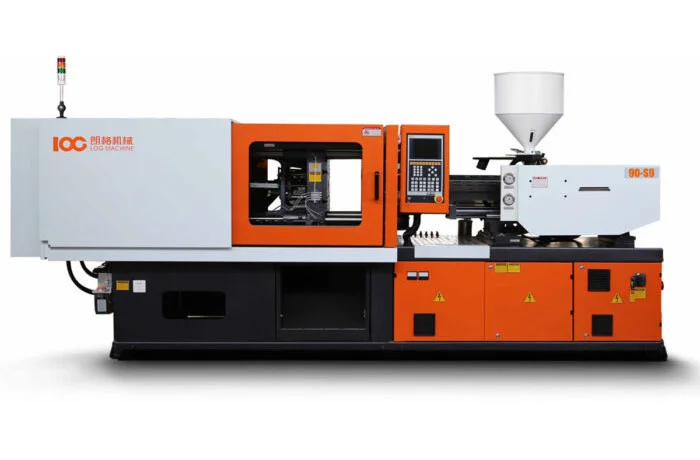
The LOG S8 injection unit uses a double-cylinder design, which delivers higher injection pressure through a simpler structure with a lower malfunction rate. The enlarged twin-cylinder arrangement also prevents the material leakage that machine vibration can cause during high-speed nozzle operation, which matters precisely on the fast, high-pressure fills where lesser designs start to misbehave.
Getting the pressure there is half of it. Controlling it through the fill is the other half. The injection cylinder uses low-friction seals specifically to improve response rate and stability through complex injection profiles, the kind where pressure and speed are changing through the shot rather than holding one flat value. On the control side, the KEBA i2880 platform monitors actual pressure and flow in real time over a high-speed bus, so the pressure the part sees is the pressure you set rather than an approximation of it.
None of this changes the physics of your part. What it changes is how faithfully the machine delivers the pressure profile that physics demands, shot after shot.
The question to ask before you buy
Not just “how much pressure can it make,” but: can it deliver the pressure my part needs, hold it stable through a changing fill, and repeat it every cycle? A peak pressure figure on a spec sheet is a ceiling, not a promise of control on the way up to it.
If you know your part is difficult to fill, thin walls, long flow lengths, a stiff or filled resin, that is worth raising before the machine is specified, because it affects both the injection unit and the tonnage together. Send us the part geometry and resin through the application worksheet and our application engineers will look at fill pressure and clamping force as the single linked question they actually are. You can also compare specifications directly on the individual model pages, from the S8 130 ton through the S8 250 ton and up.
See the machines running
Our YouTube channel carries machine demonstrations across the S8 and S9 ranges, which is a reasonable way to see how these machines behave before you get into specifications.
After the sale
Spare parts for LOG machines are available through Virtus Equipment Direct, our online store. Our field service engineers are certification-trained, and we offer operator training and processing assistance, including mold tests and help with difficult engineering resins, because a correctly specified machine still has to be run correctly.
Frequently asked questions
What is the difference between injection pressure and holding pressure?
Injection pressure fills the cavity, driving melt to the far corners before it freezes. Holding pressure takes over once the cavity is essentially full, compensating for the shrinkage that happens as the plastic cools. They are separate phases, set separately, and doing different jobs. Fill pressure is about getting there; hold pressure is about staying full while the part shrinks.
Why does my part have sink marks if injection pressure is high?
Sink marks are usually a holding-pressure problem, not a fill problem. If the part fills but sinks, raising injection pressure tends to add flash without curing the sink. The pressure to look at is the hold phase, which is what compensates for cooling shrinkage. Diagnosing the right phase saves a lot of wasted adjustment.
How does injection pressure relate to clamping force?
The pressure inside the cavity pushes the mold open, so higher injection pressure requires more clamping force to hold the mold shut. Thin-walled, long-flow, or stiff-resin parts need high fill pressure and therefore more tonnage. The two specifications describe the same physical event from opposite sides, which is why they should be sized together.
Does a servo machine deliver injection pressure differently?
The physics of what your part needs does not change, but delivery and control do. The LOG S8 double-cylinder injection unit produces higher injection pressure through a simpler structure, low-friction seals keep pressure stable through complex fill profiles, and the KEBA i2880 control monitors actual pressure in real time. The result is that the pressure the part sees tracks the pressure you set, cycle after cycle.
Terms worth knowing
Injection pressure. The pressure driving the filling phase, which pushes melt into the cavity before the melt front freezes off. It is the pressure that determines whether the part fills completely.
Holding pressure. The pressure applied after the cavity is essentially full, compensating for shrinkage as the part cools. Also called pack or hold pressure. It governs sink, voids, part weight, and dimensional consistency.
Transfer point. The moment control switches from the injection phase to the holding phase. Getting it right is important enough to warrant its own treatment, covered later in this series.
Short shot. An incomplete part caused by insufficient fill, whether from too little injection pressure, too little material, or a freeze-off before the cavity filled. It is a filling-phase defect.
Sink mark. A surface depression over a thick section, caused by shrinkage that holding pressure failed to compensate for. It is a holding-phase defect, not a filling-phase one.