The resin you pick decides your part’s strength, appearance, chemical resistance, and cost, and it decides how hard the material is to run on the machine. Pick wrong and you pay for it in scrap or field failures. Here is how to match material to part.
Injection molding is often described as a single process, but in practice it is a process with a very large menu attached. The resin you select determines the strength, durability, appearance, cost, and performance of the finished part, because different plastics offer different levels of impact resistance, heat resistance, chemical resistance, flexibility, and dimensional stability. Choosing the cheapest resin per pound is a common trap: selecting the wrong material can raise your total production cost even when the raw material was less expensive, once you account for scrap, rework, and warranty returns.
This guide covers the six workhorse resins you will encounter most often, then walks through the four questions that actually drive a good selection.
The six resins you’ll meet most often
Most molded parts across consumer goods, packaging, appliances, and automotive components are made from a surprisingly short list of thermoplastics. Here is how the common ones compare.
| Resin | Standout strengths | Watch out for | Typical parts | Relative cost |
|---|---|---|---|---|
| ABS Acrylonitrile Butadiene Styrene |
Tough, impact-resistant, dimensionally stable, high-gloss finish, affordable for an engineered resin. | Limited outdoor / UV and high-heat use without modification. | Enclosures, housings, toys, medical devices, automotive trim. | Low–Moderate |
| PP Polypropylene |
Most economical option; excellent chemical resistance; flows readily with a forgiving process window; great for living hinges. | Lower stiffness and impact strength; can shrink and warp. | Caps and closures, containers, housewares, hinged parts. | Low |
| PC Polycarbonate |
Very high impact resistance across a wide temperature range; optically clear grades; low shrink and good dimensional stability. | Some chemicals attack it; higher cost than commodity resins. | Lenses, safety guards, clear covers, electronic housings. | Moderate–High |
| Nylon (PA) Polyamide, e.g. PA 6, PA 66 |
Excellent wear resistance, low friction, strong thermal and impact properties; glass-filled grades add stiffness. | Absorbs water, which shifts dimensions; prone to shrinkage, so heat control matters. | Gears, bushings, conveyor parts, zip ties, under-hood components. | Moderate |
| POM (Acetal) Polyoxymethylene |
High stiffness and excellent dimensional stability; low friction; precise, “slippery” parts. | Narrower processing window; not for high-heat extremes. | Gears, cams, fasteners, precision mechanical parts. | Moderate |
| PC/ABS Polycarbonate-ABS blend |
Combines PC impact strength with ABS chemical resistance and processability; strong structural integrity. | Costs more than either parent resin alone. | Device housings that face aggressive cleaning agents, battery housings, automotive interiors. | Moderate–High |
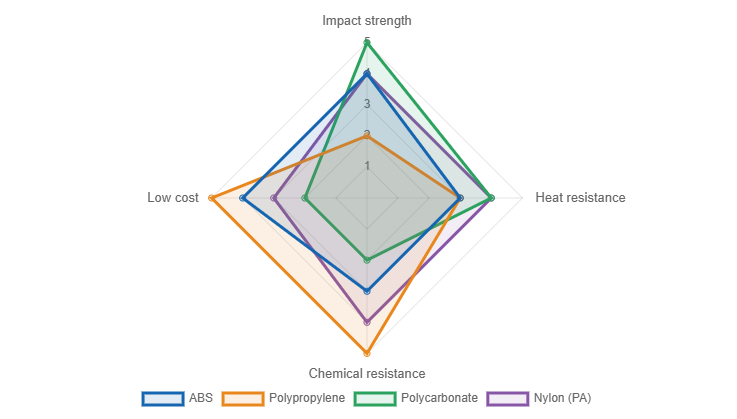
Property trade-offs at a glance
Relative comparison across four properties, scored 1 (lower) to 5 (higher) from the qualitative descriptions in the cited sources. Use as a directional guide, not a datasheet.
The four questions that drive the decision
1. What mechanical stress will the part see?
Start with strength, stiffness, and toughness. If the part must survive impact or rough handling, tough resins such as ABS or polycarbonate are the natural starting point. If a part needs the impact resistance of PC but also has to resist harsh chemicals, a PC/ABS blend often solves both at once, which is exactly why one application engineer recommended PC/ABS over polypropylene when a part needed more structural integrity than PP could give.
2. What is the thermal and chemical environment?
A part under the hood of a car, near a heating element, or exposed to aggressive cleaners has very different needs than an indoor housing. Nylon and POM handle heat and wear well; PC holds up across a wide temperature range; and blends or glass-filled grades extend the envelope further. Watch the interactions: nylon absorbs moisture, which can shift its dimensions and strength, so it is a poor pick for a part that lives in a wet environment unless you plan for it.
3. How easy is the resin to process at volume?
This is the question buyers most often overlook. ABS, PP, PE, and high-impact polystyrene flow readily and have relatively forgiving process windows, which makes them ideal for high-volume production with fewer headaches. High-performance thermoplastics such as PEEK or LCP, by contrast, require equipment capable of very high melt temperatures and demand precise mold-temperature control. The resin you choose sets the requirements for the machine that runs it.
4. What do budget and volume allow?
Commodity plastics such as PP, PE, and PS are low-cost per pound and suited to economical high-volume production, with ABS relatively affordable for the performance it delivers. As you move up into engineering plastics such as PC, POM, nylon, and PBT, cost increases but you gain specific performance benefits, and high-performance resins sit higher still. The goal is the cheapest resin that still meets every requirement, not the cheapest resin overall.
Where the machine comes in
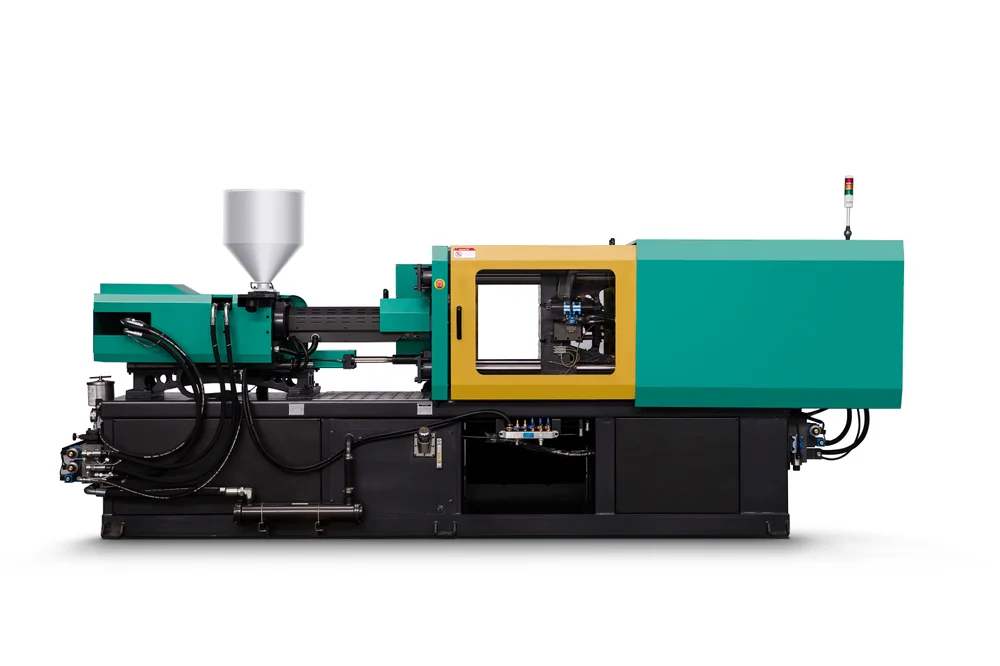
Every resin above puts different demands on the press: melt temperature, injection pressure, clamp tonnage, and screw design all shift with the material. That is why LOG’s S8 and S9 Series servo machines are built to hold precise, repeatable control across a range of materials, and why our application engineers offer processing assistance, including mold tests and help with difficult-to-process engineering resins. If you are matching a new resin to a machine, that support is there to keep you from learning the hard way.
Key terms
- Thermoplastic
- A plastic that melts when heated and solidifies when cooled, and can be re-melted. Nearly all injection molding resins are thermoplastics.
- Semi-crystalline resin
- A polymer whose molecules form ordered regions on cooling (for example nylon and POM). These tend to have sharp melting points and can shrink more than amorphous resins.
- Amorphous resin
- A polymer with no ordered crystalline structure (for example ABS and polycarbonate). These often offer better dimensional stability and clarity.
- Processing window
- The range of temperatures and pressures over which a resin molds well. A wide, forgiving window (as with PP and ABS) makes high-volume production easier.
- Glass-filled grade
- A resin blended with glass fiber to raise stiffness, strength, and heat resistance, at the cost of higher wear on the machine and possible warp.
Frequently asked questions
What is the cheapest plastic for injection molding?
Among the common resins, polypropylene is usually the most economical option, along with other commodity plastics like polyethylene and polystyrene. However, the cheapest resin per pound is not always the cheapest overall: choosing a material that cannot meet the part’s requirements can raise total cost through scrap, rework, and field failures.
What is the difference between ABS and polypropylene?
ABS is a tougher, more rigid, dimensionally stable engineering resin with a high-gloss finish, well suited to housings and enclosures. Polypropylene is cheaper, flows more easily, resists chemicals better, and excels at living hinges, but it is less stiff and less impact-resistant and can warp. The right choice depends on the part’s mechanical and cosmetic needs.
Which injection molding resin is best for high-impact parts?
Polycarbonate offers very high impact resistance across a wide temperature range, and ABS is a tough, more affordable option. When a part needs both impact strength and chemical resistance, a PC/ABS blend combines the strengths of both.
Why does nylon absorb water, and does it matter?
Nylon is a semi-crystalline polyamide that naturally absorbs moisture, which can shift its dimensions and reduce strength. It matters for parts used in wet or humid environments; in those cases you either design for the movement, choose a different resin, or specify a grade formulated to limit absorption.
How does resin choice affect the injection molding machine?
Each resin has different melt temperature, injection pressure, clamp tonnage, and screw requirements. High-performance resins like PEEK need very high melt temperatures and precise mold-temperature control, while commodity resins run on more forgiving settings. Choosing the resin effectively sets the requirements for the machine that runs it, which is why matching the two matters.
Match the right machine to your material
Explore LOG’s servo injection molding machines and parts, or see our machines running real production parts.