Before making any capital equipment decision, understanding the market your business operates in is worth the time. Where demand is growing tells you where your production capacity will be most valuable. Where technology is moving tells you whether the machine you buy today will still be competitive in five years. And where regulations are heading tells you what your operating costs look like going forward.
The injection molded plastics market reached $362.47 billion in 2025 and is projected to reach $481.42 billion by 2033 at a compound annual growth rate of 4.0 percent, according to Grand View Research. In volume terms, the market is expected to hit 157.13 million tons in 2025 and grow to 193.76 million tons by 2030. These are not niche numbers. This is one of the largest manufacturing sectors in the world, and it is still expanding.
The Fastest-Growing Segments: What They Require From Equipment
| Application Segment | Growth Rate | Equipment Implications |
|---|---|---|
| Medical devices | 4.43-5.94% CAGR | ISO 13485 cleanliness, precision dimensional tolerances, all-electric or servo-hydraulic strongly preferred, regrind restrictions often tight or zero |
| Automotive (EV components) | 5.12% CAGR | Large-tonnage capability, structural part precision, glass-filled resins require machine durability; EV battery casing applications driving higher tonnage demand |
| Consumer electronics | Growing rapidly | ABS and PC dominance, thin-wall capability, tight cosmetic tolerances, fast cycles; servo-hydraulic or all-electric for precision and repeatability |
| Food and beverage packaging | 3.7% CAGR | High-cavitation multi-cavity tooling, PP and PE dominance, fast cycles with high repeatability, closed-loop recycling programs increasingly required |
| Sustainable packaging | 7.2% CAGR | Recycled content requirements increase; closed-loop regrind programs become operationally necessary; energy-efficient machines reduce per-part environmental cost |
The Machine Technology Shift: Where the Industry Is Going
Hydraulic injection molding machines still dominate global installations, holding about 51 percent of the market in 2024. However, the directional shift is clear and consistent across multiple market analyses. Electric machines are growing at 5.54 percent annually. Servo-hydraulic machines are capturing share from conventional hydraulic systems across mid-tonnage applications. By 2034, the electric and servo-hydraulic combined share is projected to be substantially larger than it is today.
The drivers are the same ones that have been building for several years: energy cost pressure, precision requirements in medical and electronics applications, and EPR-driven sustainability metrics that include machine energy consumption in the per-part environmental footprint calculation. As one 2026 market analysis noted, EPR fees projected at $4.7 billion in the U.S. alone are acting as de-facto material taxes, increasing total landed costs for conventional resins and pushing manufacturers toward machines and processes that reduce per-part input costs.
Why Servo-Hydraulic Wins in Mid-Tonnage Applications
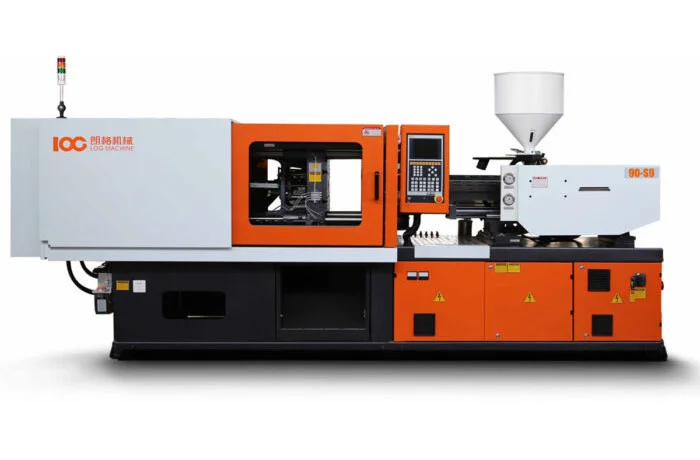
The LOG S8 and S9 series sit in the 90 to 650-ton range, which is where most general-purpose, packaging, and mid-size automotive applications live. Servo-hydraulic in this range offers the force capacity of hydraulic with significantly better energy efficiency and process control, at a lower initial cost than all-electric in equivalent tonnages.
Why Medical and Electronics Drive S9 Demand
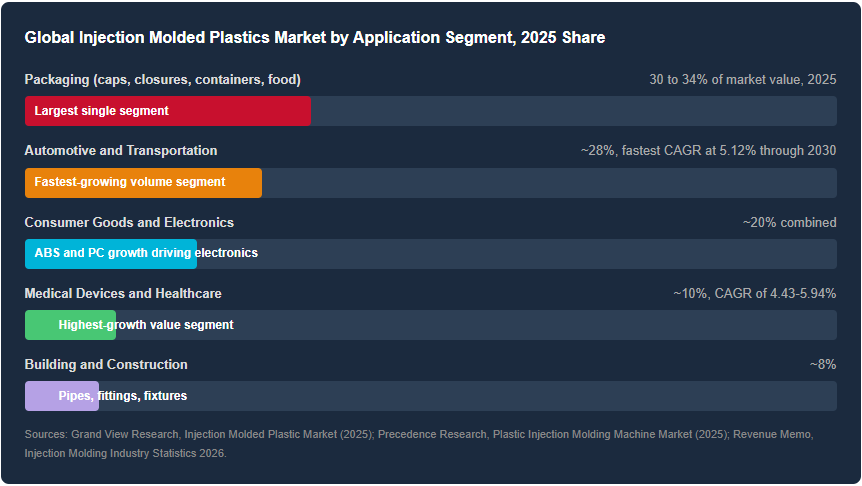
The medical device segment’s 4.43 to 5.94 percent CAGR is the fastest in the industry by value. Medical molding requires the precision, repeatability, and advanced closed-loop control that the LOG S9 series is specifically optimized for. This segment’s growth is creating direct demand for the capabilities the S9 platform delivers.
What This Means If You Are Buying Equipment in 2026
Three practical conclusions follow from the market picture. First, packaging remains the highest-volume application and will for the foreseeable future. If your operation primarily serves packaging customers, the economics of servo-hydraulic presses at mid-tonnage are compelling right now, and the energy savings accrue every shift for the life of the machine.
Second, if you are considering a move into medical, electronics, or any precision application, the investment threshold for the machine platform that serves those markets is the LOG S9 series. The difference between an S8 and an S9 in general packaging terms is moderate. In medical or precision electronics terms, the control system capability is the gateway to being competitive at all.
Third, the sustainability and recycled content story is not going away. Operations that can document their energy efficiency and closed-loop material management are better positioned in customer supply chains than those that cannot. Servo-hydraulic machines contribute measurably to both metrics.
View the LOG S8 Series View the LOG S9 Series Processing Assistance Shop Virtus Equipment Direct