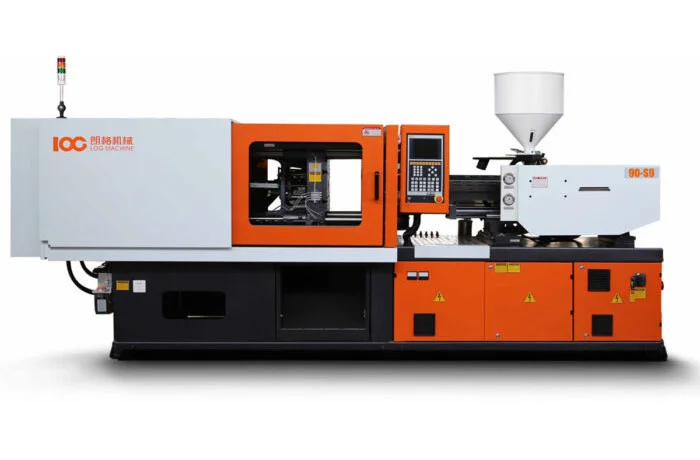
This is one of the most common questions our team gets. A customer knows their clamping tonnage, and both the S8 and S9 cover that range across configurations from 90 to 650 tons. So what is the actual difference, and why does it matter?
The answer starts with what the machines share, because the shared foundation is substantial, and then moves to where the two series diverge in meaningful ways for specific applications.
The Context: Why Servo-Hydraulic Is the Right Starting Point
Before comparing S8 versus S9, it is worth understanding why servo-hydraulic drive technology matters in 2026. Research published in the Journal of Cleaner Production found that electrical energy accounts for 30 to 45 percent of total operational costs in a serial injection molding cell. That is a significant cost center, and it is one where drive technology makes a direct difference.
Conventional fixed-speed hydraulic presses run their pump motor continuously, whether the machine is injecting, cooling, or simply waiting. A servo-hydraulic press only draws power when the machine is actively doing work. During cooling time, dwell, and other non-active phases, power consumption drops substantially. Both the S8 and S9 deliver this advantage.
Where the S8 and S9 Differ
| Feature | LOG S8 Series | LOG S9 Series |
|---|---|---|
| Clamping range | 90 to 650 tons | 90 to 650 tons |
| Drive system | Servo-hydraulic | Servo-hydraulic, advanced configuration |
| Primary target applications | General production, packaging, consumer goods, daily necessities, standard tolerances | Higher precision, technical parts, medical, thin-wall, demanding tolerance requirements |
| Injection speed and response | Strong performance for standard production cycles | Enhanced for faster, more precise injection profiles and multi-cavity high-speed tooling |
| Control system | Full CNC with production monitoring | Advanced closed-loop control with expanded data integration capability |
| Value position | Excellent production results at a strong value point | Higher specification for applications where the precision pays for itself |
Application Fit: How to Think About It
LOG S8: Strong Application Fit
Consumer product molding, packaging, household goods, containers, caps and closures, general automotive components, and any thermoplastic application with standard tolerances running at moderate cycle speeds. The S8 delivers reliable, consistent production at a value that holds up well in total cost of ownership comparisons.
LOG S9: Strong Application Fit
Thin-wall packaging, medical device components, technical automotive parts with tight dimensional requirements, high-speed multi-cavity tooling, parts where shot-to-shot consistency directly drives product quality, and applications where process data integration is a requirement rather than a preference.
Total Cost of Ownership: What Matters Most
Machine purchase price matters, but it is only one part of the calculation. For injection molding presses running two or three shifts per day, electricity is a recurring cost that compounds across every shift, every year the machine operates. A servo-hydraulic press that reduces electricity consumption by 35 to 40 percent versus a conventional hydraulic press delivers that savings continuously, not just in year one.
LOG IMM can provide reference consumption data for specific S8 and S9 configurations. The comparison against your current press is usually a straightforward conversation, and it gives you the numbers to evaluate total cost of ownership rather than just sticker price.
View the LOG S8 Series View the LOG S9 Series Shop Virtus Equipment Direct